
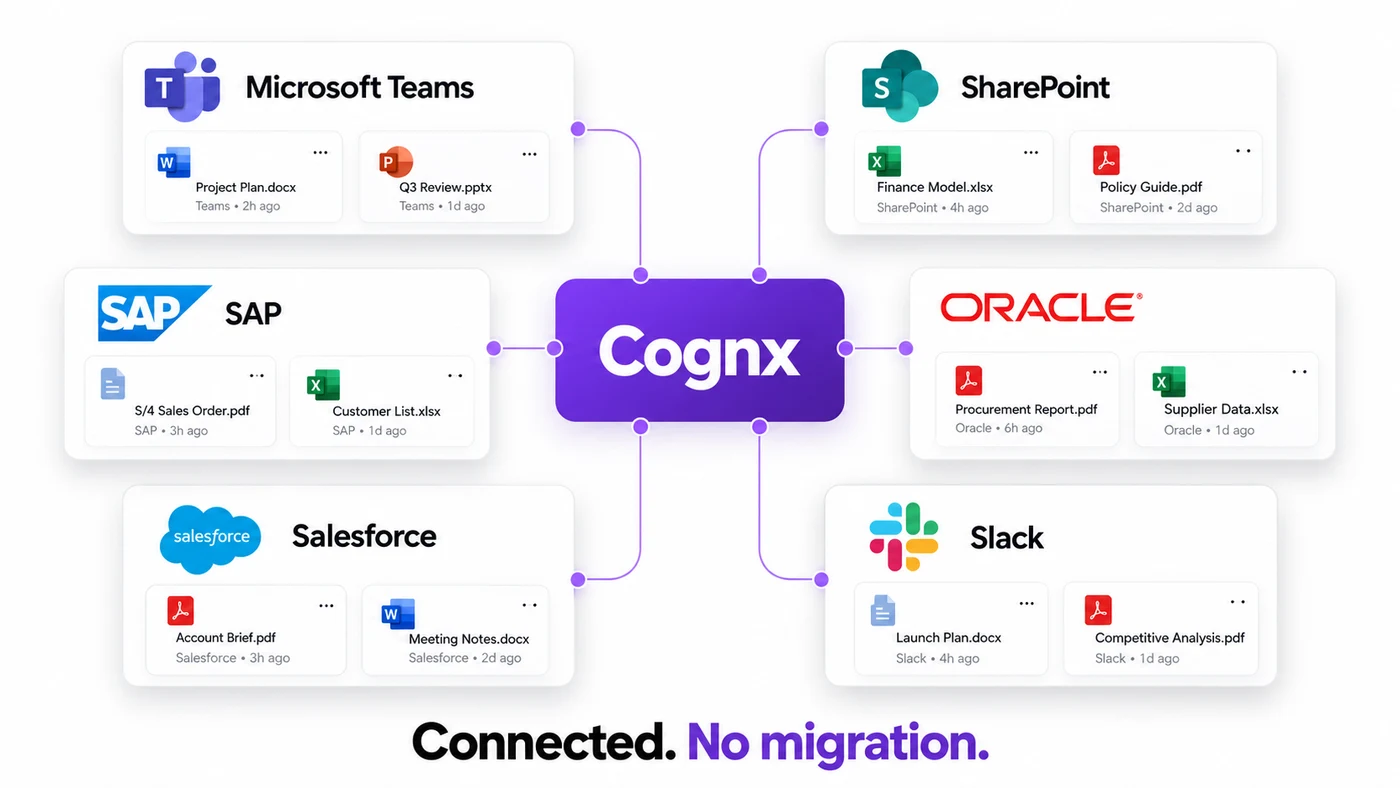
Your organisation has already chosen tools for documents, collaboration, customer relationships, and operations. Bringing knowledge together should begin by understanding those systems, not by assuming everything must move into a new repository.
Connect around the work people already do
A service team might need a procedure from its document platform, a discussion from its collaboration tool, and a case status from its operational system. A shared knowledge experience can bring those sources into one question without replacing the applications that own them.
The underlying system remains the place where its records are maintained. The knowledge layer helps people discover and interpret relevant information across those boundaries. That distinction keeps responsibility for corrections clear.
A connector is more than a logo
A useful connector needs an authentication method, a defined content scope, and a way to handle source changes. It must also deal with pagination, rate limits, errors, and permissions. For some systems it retrieves indexed content; for others it queries an approved API when needed.
A displayed integration logo does not establish which objects, editions, or operations are supported. Confirm the exact use case: reading documents is different from reading comments, querying transactions, or updating a record. Compatibility should be checked against the proposed deployment.
No migration does not mean no data processing
Connecting a system can avoid a wholesale content migration or repeated manual exports. It may still involve processing excerpts, building a search index, storing embeddings, or caching permitted results. Those choices affect retention, security, and where data is held.
Document what is copied, where it is stored, how long it is retained, and how changes and deletions propagate. Make these choices explicit before connecting sensitive sources.
Roll out one useful connection at a time
Choose a source with clear ownership and a recurring business need. Agree which users and records are in scope, test representative questions, and verify what happens when access is revoked. Include a failed synchronisation in the test so the user experience remains honest when the source is unavailable.
Then add a second source that improves the same workflow. This makes the value of the connection easier to assess than adding a large catalogue of tools with no defined purpose.
Cognx positions integrations as a way to bring third-party knowledge into one governed view. The best starting point is a question your team needs to answer and the smallest set of supported connections required to answer it well.
Connect the sources that improve a real workflow, and make the data handling behind every connection explicit.