
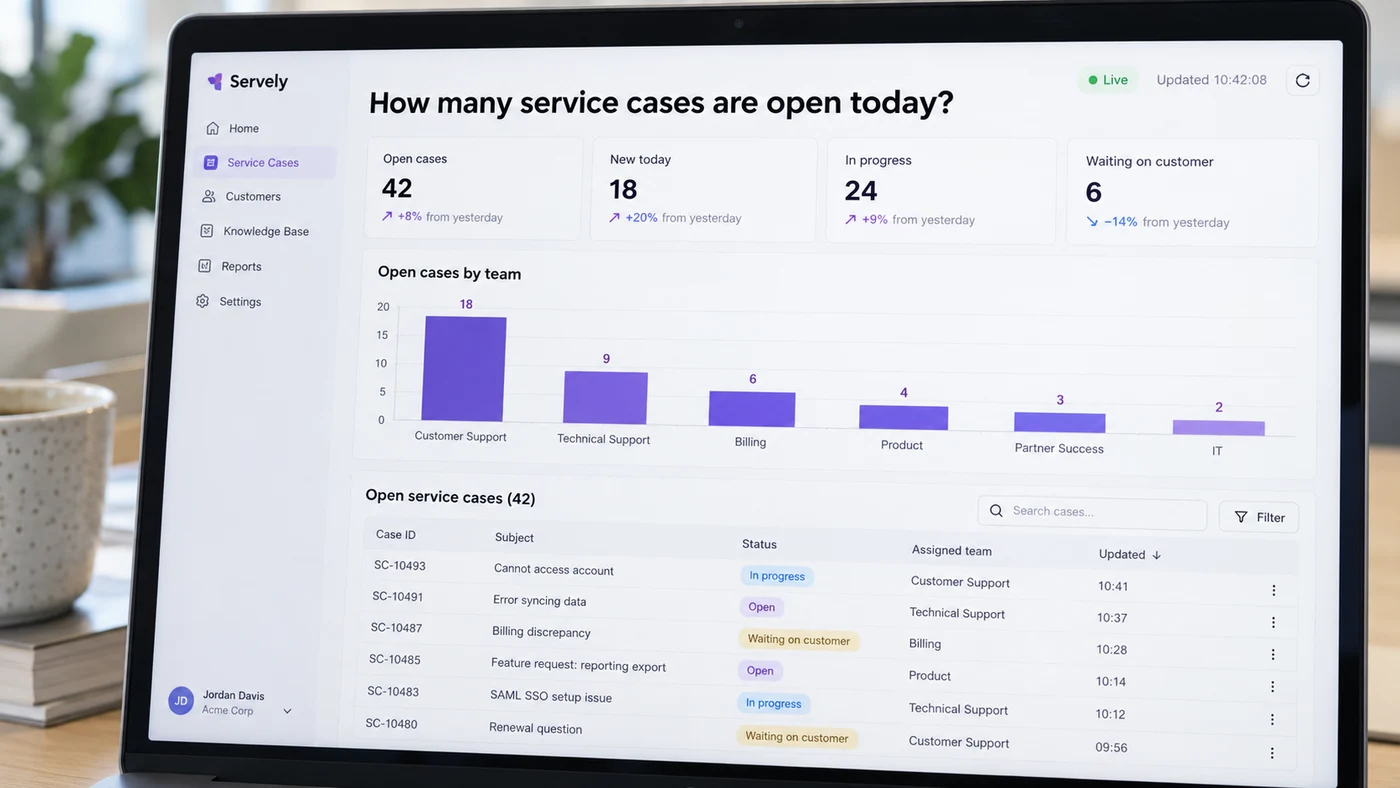
A document explains how a process should work. Operational data shows what is happening in that process. The most useful business questions often need both.
Ask a question that crosses the boundary
Imagine a service manager asking: Why are requests increasing, and which cases need attention today? A policy document can explain response-time commitments. A connected service system can supply current case counts and status. Together, they can help the manager interpret the situation.
This is an illustrative workflow, not a claim about a particular customer result. A rising count shows a change; it does not, on its own, establish the cause. A good answer distinguishes observed patterns from explanations that still need investigation.
Be precise about what live means
A direct query can retrieve data when a question is asked. An indexed source may reflect the last successful synchronisation. A cached result may be older still. Each can be useful, but they should not be presented as equally current.
Display the query time or last refresh, the period covered, and any known connection failure. If a source is unavailable, say so. Quietly substituting yesterday's result for a question about today creates misplaced confidence. Real-time access also depends on the source system, connector, permissions, and deployment configuration.
Make definitions part of the answer
Before counting overdue cases, agree what overdue means. Does the clock stop while the team waits for a customer? Are weekends excluded? Are reopened cases counted once or twice? These definitions often live in business documentation rather than in a database column.
Return the metric, its filters, and the relevant definition together. For consequential decisions, let the user inspect the supporting records or approved aggregate. A chart should make the answer easier to understand without concealing the assumptions behind it.
Keep analytics inside the knowledge workflow
Cognx brings a connected-data perspective to knowledge management: users can explore operational information as well as documents, where the required connections are configured. They should be able to move from a question to an analysis and then back to the evidence.
Start with a read-only, well-defined question and a trusted dataset. Test totals against the source system and include empty results, ambiguous dates, and restricted records in the evaluation. Expand when the team can explain both the answer and how it was obtained.
A current number is more useful when the user can see when it was retrieved, what it measures, and which evidence explains it.