
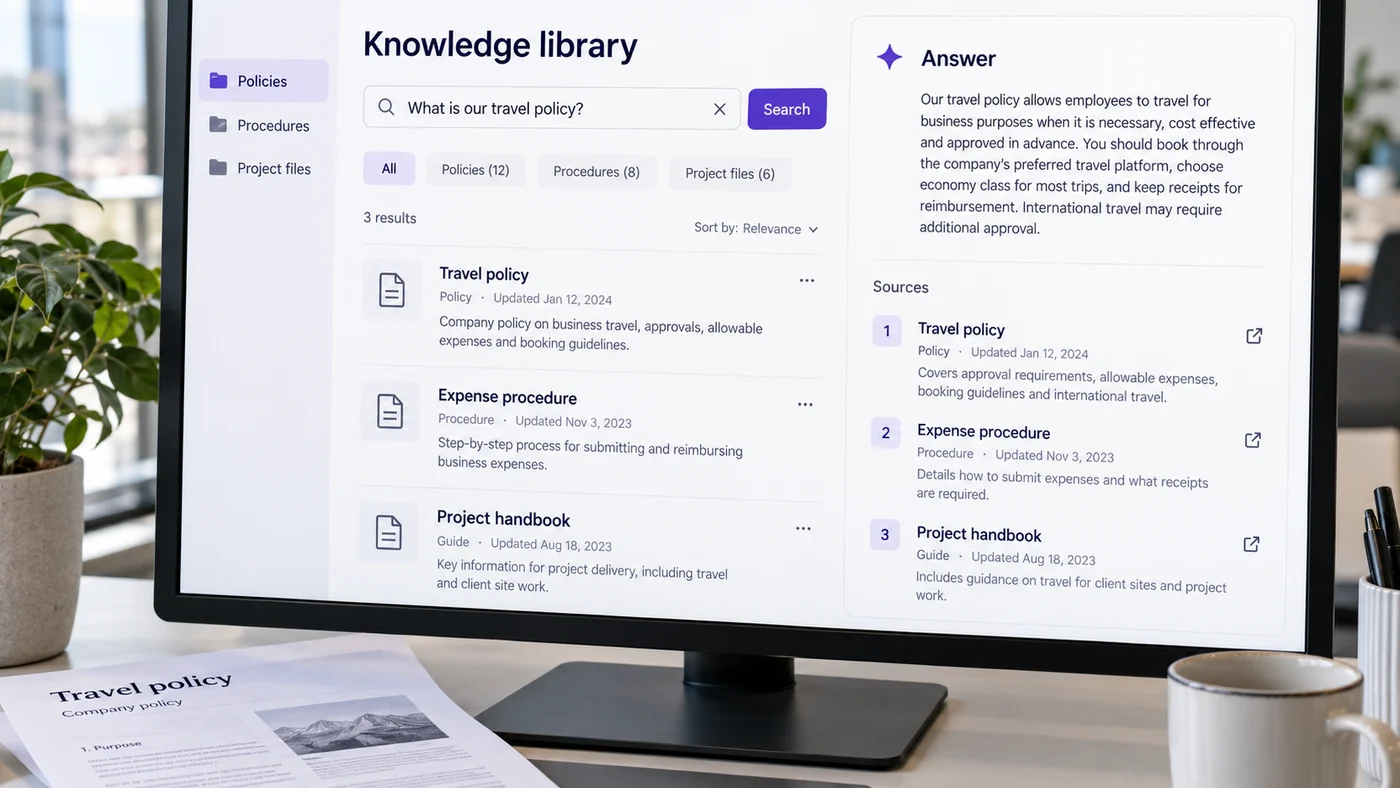
An organisation can hold thousands of documents and still struggle to answer a straightforward question. The problem is rarely a shortage of information. It is knowing which information matters, whether it is current, and who can rely on it.
From storage to understanding
Traditional knowledge management gives information a place to live. Policies go into a repository, project updates into shared folders, and operating procedures into a team workspace. These foundations still matter. But people usually approach knowledge with a question, not with a folder path in mind.
AI changes the interface: a person can ask a question in ordinary language and receive a response assembled from relevant evidence. Retrieval-augmented generation, or RAG, is one way to do this. It retrieves supporting material before a language model produces an answer. The quality of that answer still depends on the material retrieved and how it is interpreted.
Three things that make knowledge useful
First, context. A policy becomes more useful when it is connected to its effective date, the team responsible for it, and the process it governs. Second, provenance. Readers need a route back to the original source so they can verify an important statement. Third, ownership. Someone needs to maintain the material and resolve conflicting versions.
These are operating practices as much as technical features. An intelligent search interface cannot decide, by itself, which of two contradictory policies your organisation has formally approved.
Start with one recurring question
Consider employee onboarding. A new colleague asks which approvals are needed to obtain access to a business system. The answer may depend on their role, location, and the system involved. A useful knowledge experience brings together the relevant procedure and owner, while keeping restricted information out of view.
Start a pilot with a small set of frequently asked questions. Identify the authoritative sources, assign owners, and test answers with the people who handle those questions today. Include questions that should produce no answer because the evidence is missing.
Measure whether work improves
Track whether people find a usable answer, how often they must ask a colleague to verify it, and whether citations actually support the response. Record unresolved questions as knowledge gaps. Search volume alone does not tell you whether a team is working more effectively.
For Cognx, knowledge management is the organising idea: connected sources, grounded answers, and useful outputs belong in one flow. Analytics is one part of that experience, alongside search, conversation, and content creation. The goal is to make organisational knowledge easier to apply, with the evidence still within reach.
A stronger knowledge system connects information to its meaning, its owner, and the decision it supports.